Dual Flat Velocity Hourglass Port, The Ideal Speaker Vent
The Regular Port/Vent
The vent (or port) is designed to enhance bass response by leveraging its surface area and length. It increases the low-frequency output by functioning as a Helmholtz resonator.
Traditionally, ports are made using a cylindrical tube or a straight square or rectangular section. While these geometries are simple to manufacture, their aerodynamic performance is not equivalent.
Square and rectangular ports produce more distortion, more port noise and greater SPL compression than a properly optimized cylindrical geometry. Their larger perimeter for a given cross-sectional area also increases the amount of wall surface interacting with the moving air.
A cylindrical section is therefore a better starting point for a high-performance port, but the cross-section alone is not enough. The way the air enters and exits the port is equally important.
At high acoustic levels, the air velocity inside the port becomes large and the flow can separate from the port walls, generating turbulence and vortex shedding. These effects increase port noise, distortion and acoustic losses, while reducing the effective acoustic output of the vent. This behavior has been extensively studied and measured in bass-reflex ports.
The objective is therefore not simply to calculate the correct port area and length. The complete geometry must be optimized to control the airflow at both ends of the port.
This is the problem addressed by the Hourglass Vent.
The Hourglass Vent Demonstration
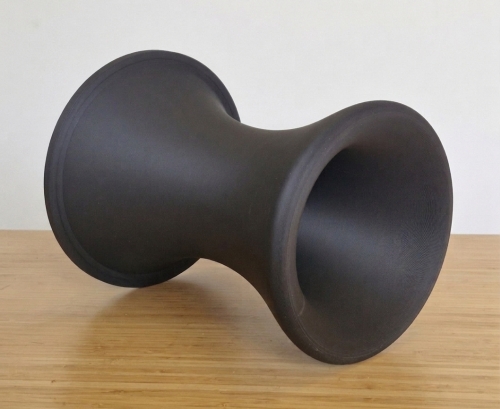
The Hourglass Vent was first theorized and simulated in 2002 by three AES members: Alex Salvatti, Allan Devantier, and Doug J. Button. This design optimizes speaker vent performance by addressing several key acoustic challenges.
Key Benefits:
-
Reduction of vent noise: Minimizes unwanted noise generated by turbulent airflow within the port.
-
Lower distortion from turbulence: Improves airflow smoothness, reducing turbulence-induced distortions.
-
Reduced dynamic compression: Prevents the vent from restricting airflow at high volumes, ensuring a more consistent energy transfer between the speaker box and the room.
Dynamic vent compression is a phenomenon where, at higher volumes, the vent starts delivering diminishing energy despite the woofer output increasing. -
Better resonance distribution: Improves the way resonances are spread within the port, leading to a smoother interaction with the system’s overall response.
This design ultimately improves efficiency and sound quality by minimizing losses and unwanted artifacts in bass reproduction.
However, while the overall shape of the Hourglass Vent is advantageous—even with a 12mm radius at the exit—it still suffers from friction and an uneven velocity profile at the exit:
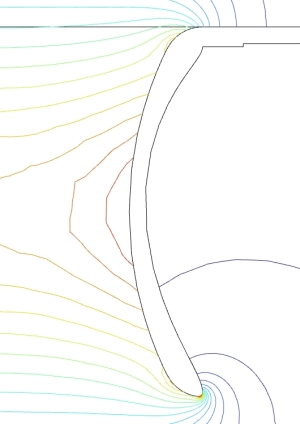
Another important factor to consider is that one extremity of the port is located on a flat panel, while the other is not. In practice, this means the profile cannot be perfectly symmetrical.
The Optimised Dual Flat Velocity Hourglass For Real Application
Our design guarantees an uniform radiation velocity both at the vent’s exit and entrance:
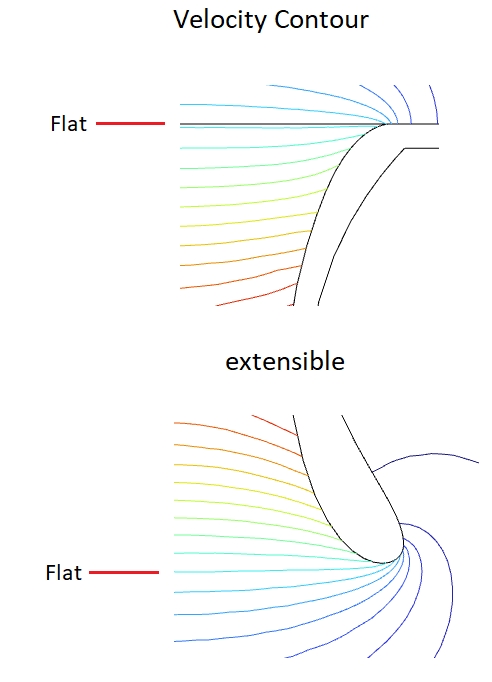
The vent consists of asymmetrical front and rear parts optimized through Finite Element Analysis (FEA). The design accounts for radiation differences — 2π at the front and 4π inside the enclosure — to ensure optimal acoustic performance thanks to flat velocity profiles at both the inlet and outlet.
The vent is screw-mounted from the front or rear of the loudspeaker, providing easy assembly.
For optimal performance, the port should be positioned at approximately 30% of the speaker height from the bottom, preferably on the rear panel.
Port Position and Cabinet Resonances
The position of the port inside the cabinet also plays an important role.
The sound radiated by the port is not necessarily limited to the intended Helmholtz resonance. Higher-frequency energy can also come from cabinet resonances and from resonances of the port itself. The position of the port therefore affects how strongly these resonances are radiated.
For this reason, we generally position the port at approximately 30% of the cabinet height from the bottom. This position is chosen to reduce the coupling with the vertical resonances of the cabinet, placing the port close to a low-radiation region of these modes.
A conventional, non-optimized port is preferably placed on the rear panel when possible, as this helps keep residual higher-frequency energy and port noise away from the direct radiation of the loudspeaker.
With the Dual Flat Velocity Hourglass, the port can also be placed on the front panel when positioned correctly. The combination of its optimized geometry, dual flat velocity profile and the 30% positioning helps minimize both port-generated noise and the radiation of unwanted cabinet resonances. This makes front mounting a practical option without requiring the port to be hidden at the rear of the cabinet.
This is one of the advantages of the Dual Flat Velocity Hourglass compared with conventional ports: when correctly positioned, it can be used on the front of the cabinet while maintaining a very clean acoustic output.
Internal damping should also be used to reduce cabinet resonances. However, it must be applied carefully around the port: excessive damping can interfere with the airflow and reduce the acoustic output of the vent. The amount and position of damping therefore need to be balanced against the required port performance.
Measurements
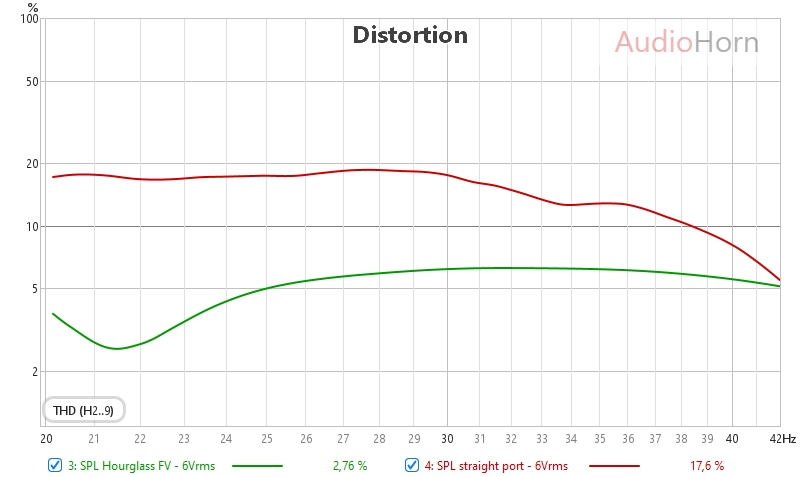
Independent measurement series conducted by Dylan, host of the YouTube channel SPL.
A two-piece, unglued port was used for the Hourglass FV; a glued and smoothed version would have performed even better.
Distortion
This graph shows the distortion measured at the port mouth, compared to a straight tube.
Vent Noise
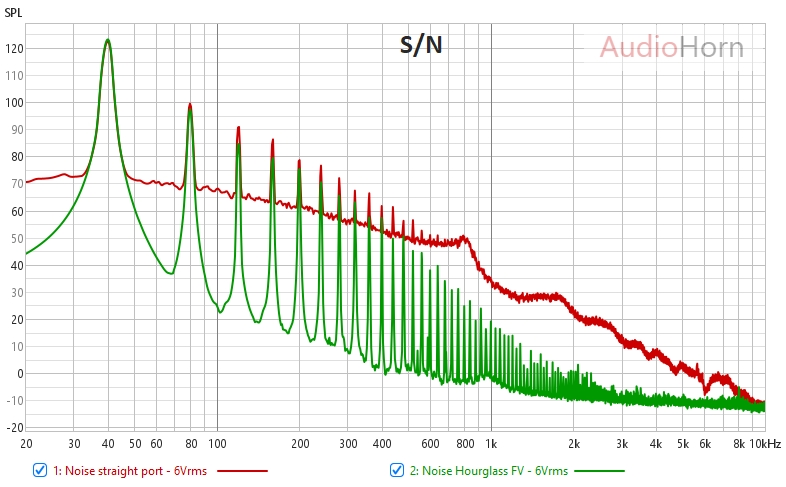
This chart presents an RTA measurement of airflow noise using a 40 Hz sine wave. The focus is on the noise floor, represented by the level between the peaks, which reflects the broadband turbulence generated by the vent.
Dynamic Compression
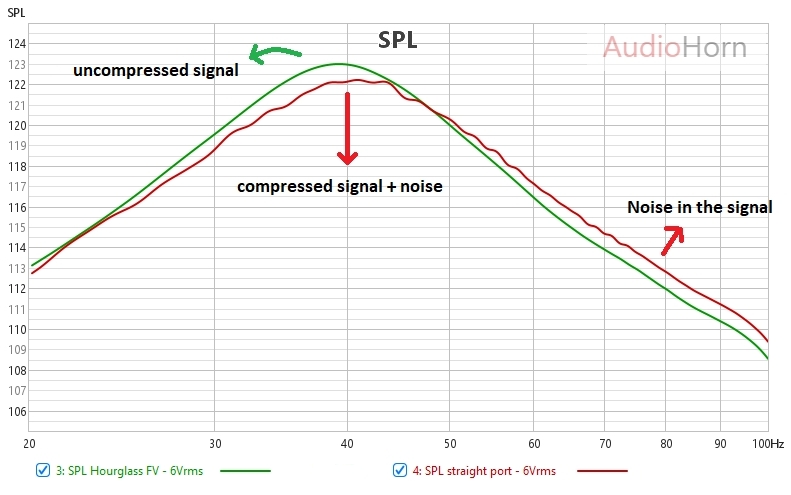
These charts show the SPL output difference for the same input signal sent to the woofer.
While the Hourglass DFV (Dual Flat Velocity) shows only a modest 2 dB increase, its output signal is much cleaner compared to the straight port, which contains significant noise that artificially raises its SPL.
This explains why the straight port SPL appears to fluctuate and remain relatively close.
To better illustrate the difference, two audio files recorded at the mouth of each port are provided for comparison of the airflow noise, showing the airflow noise for an identical rising 40 Hz SPL:
System & Prices
The price of the Hourglass Dual Flat Velocity Port is determined by demand and production costs, while the design is developed using FEA in accordance with client specifications.