PureShape SB26
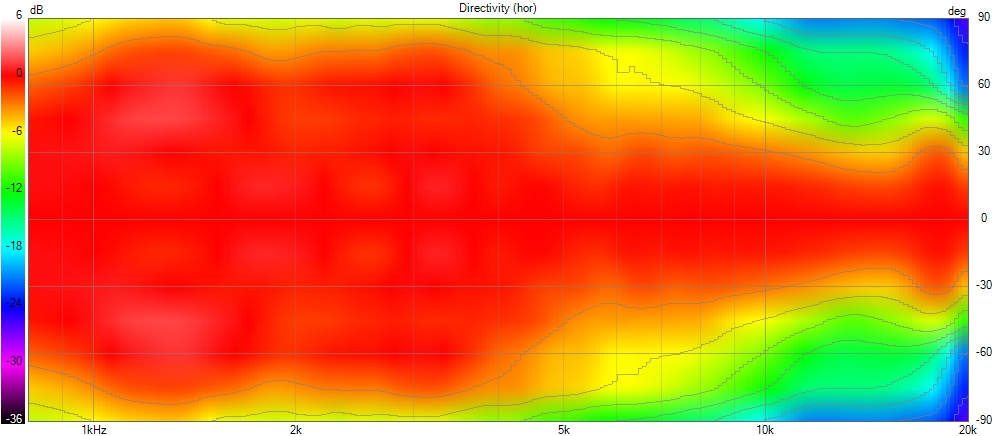
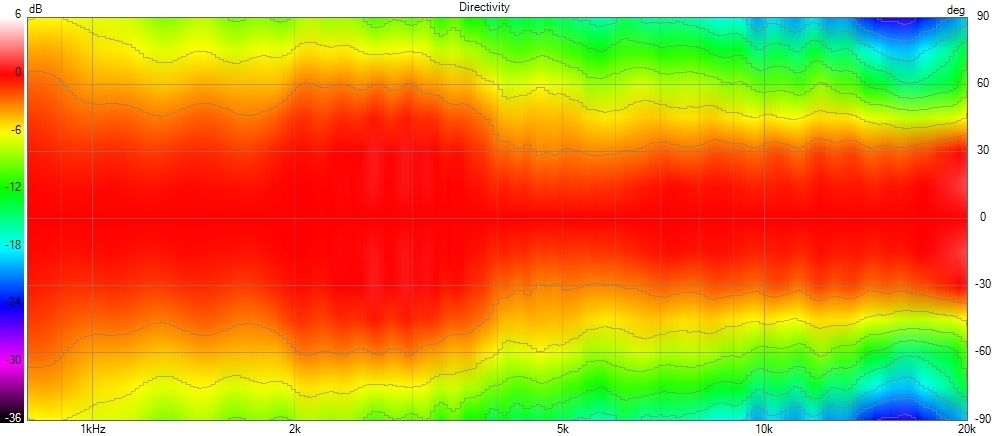
Directivity polar plot
All measurements are real ones, performed with the ideal 25mm roundover return, taken at 1/24 resolution in a half-space presentation (±90°).


SPL
The waveguide is easy to filter, even passively, it only requires two high-shelf EQ filters: +7 dB @ 3000 Hz and +4 dB @ 7500 Hz (with the default Q = 0.707) to be corrected.
The loading effect provides 10 dB of sensitivity compared to direct radiation in the low end, allowing for a low crossover point with high SPL.


Distortion
Its loading capacity allows operation at very low frequencies. The radiation restriction, combined with the reactive loading effect, reduces the tweeter’s required excursion to achieve a given SPL after equalization to a flat response, leading to lower distortion.
Intermodulation distortion (IMD) is also reduced, since both harmonic and intermodulation distortions are strongly linked to driver nonlinearities, which generally increase with diaphragm excursion.
Below is the H3 distortion for the 18 cm and 22 cm versions at 95 dB SPL (1 m), measured with EQ applied to achieve a flat and identical response from 1 kHz for both:

Note: The 3rd harmonic (H3) appears up to about 6.66 kHz because at that point it already corresponds to 20 kHz, thus producing an unwanted 20 kHz tone. A 3rd harmonic distortion produces an unwanted tone at three times the fundamental, 3 × 6.66 kHz = 20 kHz.
How it competes versus Direct Radiation (no WG) and Somasonus
Mounting
We recommend a round-over return of around 25mm radius on each exposed side to eliminate midrange narrowing and beaming.
Mounting is done with the baffle using M4 screws into a rebate 12 mm large, 8 mm high, with 4 mm radius corners.
Tweeter mounting is done as show here, users has to remove the face plate but reuse the screm and put it back in place, they will serve as a centering device
The fix system with his two M4 screw is provided too.

